Monday, February 23, 2015

Trolls


TROLLS - 1992

Trolls

Do you remember the delightful children€™s story, €œThree Billy Goats 
Gruff€?  The story told of a Troll who lived beneath a bridge and was very mean to everyone that went over his bridge. This was one of my favorite stories as a child.  If you have never heard of it, I suggest you take time to watch this you tube video of it.

https://www.youtube.com/watch?v=OO-5KgcfHmI


In the early 1960'€™s a Danish Artist, Thomas Dam began to carve Trolls from wood to sell. These Trolls were an overnight success. Trolls began to be made in vinyl by many manufacturers and continue to be made today. The manufacturer marks are usually on the back of the Troll'€™s neck, bottom of the foot, or in the middle of the back. Many Troll novelty items have also been made: figurines, pencil toppers, calendars, key rings,tee-shirts, charms and jewelry to name a few.
Thomas Dam Trolls

The Dam Trolls are considered the most collectible with Uneeda's
Wishniks and Norfins made in Denmark and distributed in the US by EFS Marketing of New York, a tie for close second. Many have Made in Japan or Made in Hong Kong as their only identifying mark. Some are simply not marked. Most of the Trolls have plastic inset eyes with amber being the most common color. You can also find Troll€™s with painted eyes and even rhinestones for eyes. The vinyl used to make Trolls can be very heavy (usually the earlier trolls) to very light weight. The skin tones range from tan to a white palor. The hair can be nylon, mohair, or even animal fur and is usually glued to the top of the head. The hair colors are usually very bright and range all spectrums of color.

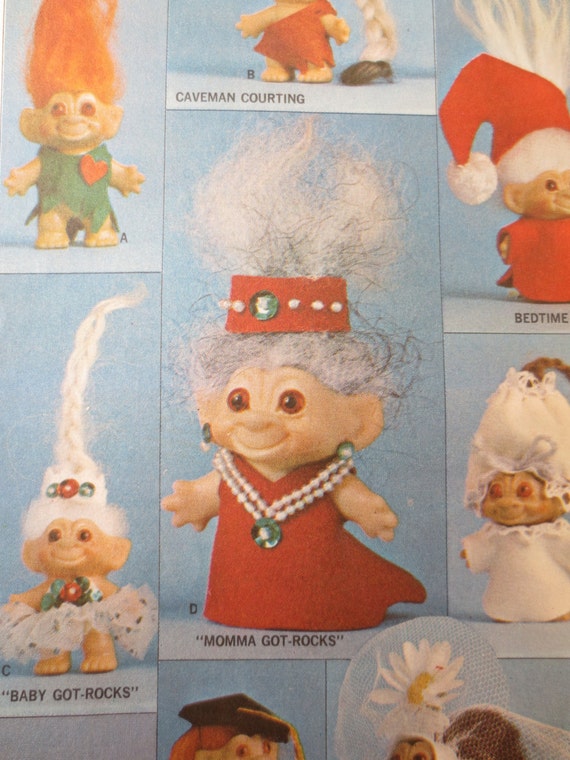
Image result for free pictures of troll dolls to copy


Clothing made for the Trolls is usually heavy felt or cotton. Some 
are not dressed. The most common trolls are dressed in a two piece 
boy or girl outfits made from heavy felt. The girl Trolls usually 
have a matching ribbon in their hair. There are many extra outfits 
made for Trolls and there are even patterns for those wishing to make clothing for their Trolls. Many Trolls have been dressed as
characters such as: bride and groom, pirates, sailors etc. Some have molded clothing or painted on clothing.


Picture on front of McCalls pattern for Trolls from 1964.

Early Trolls made by Dam, Uneeda and Norfin and Trolls that are still dressed in their original clothing are extremely popular with
collectors. Also unusual Trolls issued in small numbers also are 
sought after. Another popular Troll category with collectors is 
animal Trolls and Trolls with two heads.

[Handsome+Pita.jpg]

Trolls and Troll related items can still be very easily found and
they are still undervalued and can be very nice inexpensive items to collect.

Note from Betty. One of the cutest Christmas displays I have seen 
was one using Trolls dressed as elves. The Trolls were dressed in 
red and white striped pants and a Santa hat perched on each head. 
The pants and hats were made of lightweight felt. The scene depicted SantaĆ¢€™s workshop with all the Troll elves busy making toys. In the corner of the display there were some of the Troll elves decorating a Christmas Tree. Guess what the tree decorations were? The very small inch high Trolls.
This was such a unique decoration and brought a smile to the faces of everyone that saw it.


Sunday, February 15, 2015

Bleuette - I Love Bleuette!!!!

I have loved Bleuette for a long time.  She is such a fun doll. Never heard of Bleuette, well,  Bleuette has been around and loved by little girls and collectors since 1905.    That's one hundred and seven years.  I love to sew for Bleuette.  There are hundreds of patterns on the web all in free domain.  Free domain meaning that the copyright has expired.
Original Bleuette dolls have not been commercially made since early 1960.  Today Bleuette dolls are made by reproduction artists to satisfy the  demand for affordable dolls as an original Bleuette can cost thousands of dollars. Reproduction Bleuettes can cost from  a little less than a hundred dollars up to $500.00, depending on artist and quality of the doll. There are many ready made clothes on ebay for Bleuette. Go to ebay and type Bleuette in the search to see all that is available there. Bleuettes are 10 1/2 to 11 1/4 inches tall.  There are joints in the knees and elbows.  Her head is made of porcelain and her body is either composition or paper mache. There are two bodies for Bleuette and five different faces, which make her very interesting.  All of my Bleuettes are reproductions as I can't afford an original.  Some have been made by me and some by other doll makers. I have about eight now. I will put a link to bleuettes history and a link to one of the many pattern sites. If you love to sew for your dolls and enjoy a doll, Bleuette is a doll to consider.  On the web there are many active Bleuette groups.  One group, The Bleuette Sewing Club  issues a sewing challenge each month.  It is very interesting to see the many ideas from one pattern or idea as they post many pictures of their work. There are many very talented people in this group.   Following are some pictures of my Bleuettes.

This is Bleuette wearing her red coat that I made for her.
This Bleuette is wearing a Little House On The Prairie challenge outfit from the Bleuette Sewing Club
This group of bleuettes are wearing outfits made from a challenge several years ago to dress Bleuette in:  red, white and blue.  I really had fun with this challenge.
Another picture from the Bleuette red, white and blue challenge.  I think I got a little carried away by this one.

The pictures of the next bleuettes are dolls that I have made.  I love making dolls, but don't do much anymore.


This Bleuette perhaps my most valuable one was made by one of of the more famous Bleuette doll artists.  This particular head mold has a more baby face than the others.

Here is the link to the complete Bleuette history:

http://www.vintagebleuettes.com/bleuetteshistory.htm

This is a long article, but well worth the time to read.

Here is the link to one of  the Bleuette pattern sites:

http://www.thebleudoor.com/BleuettePatternLibraryHome.index.htm

The  original patterns are listed by the year they were released.  There are also many new patterns for Bleuette included in the site.

I hope you enjoy Bleuette and learn to love her as I do.


Monday, February 9, 2015

"Loving You Valentine" Barbie from 1983

I have been sadly downsizing my huge doll collection.  Just too many dolls and all the stuff that goes with them.  I am currently selling my vintage Barbie collection.  I have about 100 of them.  No, I don't have a number 1, a number 2 or 3.  I do have an original Midge and Alan, and many from the late sixties to the mid eighties.  Most all of mine have been played with and restored by me.  I have spent much time collecting the old clothes one piece at a time for them and researching them.  A lot of fun, but like all things, it is time to call it a day.  I have been listing some of them on ebay with limited success as most collectors of that era want mint in box.  Well as those of you that know me know I am no box collector.  I want my dolls to be handled and loved.  Not sitting in a box.    I just mailed off a very pretty Barbie to a new home and I want to share her with you. At 32 years of age she is still beautiful. She is a Valentine Barbie in her original clothing.  She is the "Loving You" Valentine Barbie from 1983.

Thursday, February 5, 2015

A Valentine For You


A Valentine For You

Some Interesting information I found on the net several years ago in celebration of St. Valentine's Day.

St.Valentine's Day
As easly as the 4th century B. C., the Romans engaged in an annual young man's rite to passage to the God Lupercus.  The names of the teenage women were placed ina box and drawn at random by the adolescent men, thus, a man was assigned a woman companian for the duration of the year, after which another lottery was staged.  After eight hundred years of this cruel practice, the early Church fathers sought to end this practice.  They found an answer in Valentine, a Bishop who had been martyred some two hundred years earlier.

According to Church tradition St. Valentine was a priest near Rome in about the year 270 A.D.  At that time the Roman Emperor Claudius ll who had issued an edict forbidding marriage.
This was around when the hayday of the Roman Empire had almost come to an end.  Lack of quality Administrators led to frequent civil strife.  Learning declined, taxation increased, and trade slumped to a low precarous level.  And the Gauls, Slavs, Huns, Turks and Mongolians from Northern Eroupe and Asia increased their pressure on the Empires boundaries.  The Empire had grown too large to be shielded from external aggression and internal choas with existing forces.  Thus more capable men were required to be recruited as soldiers and officers.  When Claudius became the Emperor he felt that married men were more emotionally  attached to their families and thus will not make good soldiers.  so to assure good quality soldiers, he banned marriage.
Valentine, a Bishop, seeing the trauma of the young lovers, met them in a secret place and joined them in the sacrement of matrimony.  Claudius learned of this, "friend of lovers" and had him arrested.  The emperor impressed with the young priest;s dignity and conviction atempted to convert him to the Roman Gods, to save him from certain execution.  Valentine refused to recognize Roman Gods and even attempted to convert the Emperor knowing the consequences fully.  On February 14, 270, Valentine was executed.

"From Your Valentine"
While Valenitne was in prison awaiting his fate, he came in contact with his jailor, Asterius.  The jailor had a blind daughter.  Asterius requested him to heal his daughter.  Through his faith he miraculously restored the sight of Asterius daughter.  Just before his execution, he asked for a pen a paper from his jailor, and signed a farewell message to her "From Your Valentine", a phrase that has lived ever after.

Valentine became a patron Saint, and spirtual overseer of an annual festival.  The festival involved young Romans offering women they admired, and wished to court handwritten greetings of affection on February 14.  The greeting cards acquited St. Valentine's name.

The Valenitne card spread with Christianity and is now celebrated all over the world.  One of the earliest surviving Cards was sent in 1415 by Charles, Duke of Orleans, to his wife, while he was a prisioner in the Tower of London.  The card is now preserved in the Tower of London.

Valentine's Day With My Dolls

My Ideal Toni dolls in their Valentine dresses having a party!
Mickey and Minnie Mouse are in love.  The perfect Valentine couple.
Another Toni in her pretty pink Valentine's Day dress.
Kissy is blowing you a kiss.  Happy Valentine's Day!

Tuesday, January 13, 2015

More Amazing Doll Information

I frequently surf the web in search of doll patterns, displays, news items or anything pertaining to dolls.  Most of the time I discover little of interest, but occasionally I hit the jackpot so to say.  I find the following to be very interesting and I hope you will also.


Extraordinary X-rays show how 150-year-old dolls were used to smuggle drugs during U.S. Civil War

Two 150-year-old dolls have been x-rayed in a bid to discover if they were used by Confederate soldiers to smuggle medical supplies past Union blockades during the U.S. Civil War.
It is thought the large dolls - Nina and Lucy Ann - had their hollowed out papier-mache heads stuffed with quinine or morphine for wounded and malaria-stricken Confederate troops.
The Union blockade lasted from 1861 until 1865 and was intended to thwart the delivery of weapons, soldiers and supplies such as medicine to the South. 
Two ladies: The dolls dubbed Nina, left, and Lucy Ann, have been X-rayed in an attempt to verify their role in the Civil War
Laid bare: Radiological technician Lanea Bare prepares to X-ray Nina under the watchful gaze of Civil War museum employee Catherine Wright
Laid bare: The X-ray image of Lucy Ann
Laid bare: Radiological technician Lanea Bare prepares to X-ray Nina under the watchful gaze of Civil War museum employee Catherine Wright, and right, the scan of Lucy Ann
Rhett Butler, the fictional rogue played by Clark Gable in the 1939 film version of Margaret Mitchell's book Gone With The Wind, was a blockade runner.
Historians believe the dolls were likely packed with supplies and shipped from Europe in the hope that Union troops would not inspect children's toys while looking for contraband. 
The dolls were taken from their home at The Museum Of The Confederacy to next-door neighbours VCU Medical Center in Richmond, Virginia, to be x-rayed.
Secret agent: Nina lies on an imaging table at Virginia Commonwealth University's Medical College of Virginia
It's what's inside that counts:An X-ray of Nina
Frankly, my dear...  Gone With The Wind's famous embrace between Vivien Leigh's Scarlett O'Hara and Clark Gable's Rhett Butler - a blockade runner
It's what's inside that counts: Left, an X-ray of Nina, and right, Gone With The Wind's famous embrace between Vivien Leigh's Scarlett O'Hara and Clark Gable's Rhett Butler - a blockade runner 
The scans proved that the contours inside their craniums and upper bodies were roomy enough to carry the medicines, as was believed. 
The next step could be forensic testing for any residual traces of the drugs.
The dolls were given to the museum by donors who said they were used to smuggle medicine past Northern blockades to Southern troops.
Nina was donated to the museum in 1923 by the children of General James Patton Anderson, who commanded the Tennessee Army of the Confederacy. She has red felt boots.
Truth or fiction? Medical staff discuss whether the dolls could have been used as legend would have it
Back to bed: Museum of the Confederacy collections manager, Catherine Wright, packs the dolls safely away after their hospital visit
Lucy Ann, who wears a salmon-colored cape and dress, was given to the museum in 1976 by an anonymous donor. She is adorned with a coral necklace.
Lucy Ann has an open gash on the rear of her bonneted head, possibly made when its contents were emptied. Nina was likely disassembled then stitched back together.
Museum officials have long believed the dolls were used for smuggling in the Civil War, but are now taking the necessary steps to try to prove it.
History comes alive: A re-enactment of the Civil War era from North Carolina, where some locals call it the War of Northern Aggression

The U.S. Civil War (1861–1865)

This was essentially a war on slavery. 
In the presidential election of 1860, the Republican Party, led by Abraham Lincoln, campaigned against the expansion of slavery beyond the states in which it already existed. 
The Republicans won the election but before Lincoln took office on March 4, 1861, seven states announced their secession from the U.S. to form The Confederate States of America. 
Lincoln's Government rejected the legality of secession, considering it rebellion, and war began on April 12, 1861, when Confederate forces attacked Fort Sumter in South Carolina. 
Eventually, 11 states joined the Confederacy to fight against the northern States - The Union.  
Crucially, the Union assumed control of the border states early in the war and established a naval blockade.
In September 1862, Lincoln's Emancipation Proclamation made ending slavery in the South a war goal.
Confederate commander Robert E. Lee won battles in the east, but in 1863 his advance was halted with heavy casualties after the Battle of Gettysburg.
Confederate resistance ended when Lee surrendered to Union military leader Ulysses S. Grant  on April 9, 1865.
Victory for the North meant the end of slavery in the United States. 
'In all of the research that I have been able to do, these are the only two confirmed smuggling dolls that I've been able to find,' said Catherine M. Wright, collections manager at the museum.
The X-rays were conducted as part of the museum's continuing research of its vast Confederate holdings, believed to be the largest in the U.S..
'People have been so interested in children's toys and dolls from the Civil War in general,' she said.
'The smuggling aspect is very captivating.'
'This has been really thrilling. It's not often that you get to research a topic that one else has ever worked with before.'
Wright carried the dolls, each two to three feet long, in a box to the radiology department of the hospital.
Radiologists took images of each doll facing up, and then on their sides.
The ghostly images of the dolls' heads and shoulders, which are stitched to the bodies, revealed the cavities, and also the safety pins used to secure their clothing.
Whilst the museum knows the dolls 'stories', little of the fact about their service to the Confederacy has ever been proven.
One theory is that they were purchased in Europe, then shipped to a Southern port with the medicines stuffed in their heads to avoid detection by the North's blockade of Southern ports.
'The idea behind the smuggling dolls is that even if a ship was boarded and searched, it was unlikely that they were going to do such a thorough search that they would find this medication hidden inside of dolls,' said Wright. 
Once the dolls reached a port, the powdered quinine would be pressed into pills for Southern troops.
Malaria was widespread among Union and Confederate troops. Some 900,000 Union troops contracted malaria during the war, leaving 4,700 dead, according to the Medical and Surgical History of the Civil War.
Statistics for Southern troops were not compiled but malaria was probably more widespread, said Robert Krick, a historian at the Richmond National Battlefield Park, which includes the site of the Confederacy's largest hospital.